realizing selflessness

Welcome to the main forum. When you are ready to start a conversation, register and once your application is processed a guide will come to talk to you.
This is one-on-one style forum, one thread per green member.
User avatar
vinceschubert
Posts: 5866
Joined: Fri Nov 04, 2011 11:02 am
Location: Australia
Contact:

Re: realizing selflessness

Postby vinceschubert » Mon Sep 07, 2026 10:32 pm

Why dangle that in front of me? Won’t that just stoke seeking, and isn’t that counterproductive?”
Fair challenge. I was trying to make the recognition feel embodied rather than merely intellectual—but, yes, framed that way it can become bait: another promised experience for K to seek and measure herself against.

So drop it. ..or rather, relegate it to the background. The dropping of seeking, when it happens, is something we can extrapolate from.
Recognition may involve softening and excitement, or it may feel completely ordinary. Nothing “psychedelic” is required, and no bodily state proves anything.

What did the dangling produce right now—longing, irritation, suspicion? Was that response chosen, and is there anyone behind it? Without the promise of a special experience, what remains to be seen?
liberation starts with recognising some illusions

http://www.1ness.info

User avatar
whoknows
Posts: 542
Joined: Fri Mar 13, 2026 7:41 am

Re: realizing selflessness

Postby whoknows » Mon Sep 07, 2026 11:07 pm

I was trying to make the recognition feel embodied rather than merely intellectual
Well, I made good use of that today, of this specifically:
can you imagine that the recognition might have a distinct bodily component—a deep softening accompanied by waves of excitement? (or something)
My pointers for my afternoon sit:
- Stay with sense perceptions. Don’t grab a thought.
- It’s “stupidly simple.”
- Fall into “Ahhh . . . of course, THIS.” Relax into THIS.
- Let the body soften, be porous, receptive.

It felt apt and good to let the body soften.

What did the dangling produce right now—longing, irritation, suspicion?
If by "right now," you mean when I first read what you'd written: I appreciated the details of the description and, more fundamentally, the acknowledgment that awakening really is, or can be seen as, an "event" in the relative world and that I don't need to somehow let go of that idea, which I'm not sure I could. But I was a little confused by the fact that you would offer a description of what awakening might feel like. I think the confusion didn't have a lot of emotion in it. It was more just a cognitive puzzlement about this pedagogical strategy, given my apparent need to let go of constructing a self through seeking. So when I wrote, "Some confusion ('Why dangle that in front of me? Won’t that just stoke seeking, and isn’t that counterproductive?')," I was reporting on something that arose, but it didn't have a lot of oomph behind it.
Was that response chosen, and is there anyone behind it?
The response wasn't chosen; it just arose. (Then a little "effort" went into articulating it.)
And this feels like an answer just coming from thought, but: No, there was no one behind it.

Without the promise of a special experience, what remains to be seen?
Hmm . . . Gonna consider that further and return later.

User avatar
whoknows
Posts: 542
Joined: Fri Mar 13, 2026 7:41 am

Re: realizing selflessness

Postby whoknows » Tue Sep 08, 2026 12:48 am

Without the promise of a special experience, what remains to be seen?
Hmm . . . Well . . .

(This seems like a trick question somehow. But I’m not sure what I mean by that.)

It feels like no-self still hasn’t been grokked. The way “I” perceive “me” and my relationship to “the rest of” reality seems basically unchanged. K still operates as if there’s an existing self “in here” looking at the world “out there.” I understand that the “sense of self” doesn’t need to totally vanish, but it seems like it hasn’t even really been disturbed or loosened up.

It feels like it still hasn’t been grokked that it’s all THIS. Of course, I’m not even sure what I mean by that exactly, but it’s something to do with realizing that what I’ve been looking for is and always has been right here — and that even not grokking it is THIS.

And it feels like it still hasn’t been grokked that awakeness is and always has been right here — that there’s no one who needs to “awaken,” that “awakening” is, if anything, just a dropping of something, or not even that but just seeing through an illusion.

I’m getting this weird feeling that I’m trying hard to defend the thesis that “I am not awake.” But why would I want to defend that? (And just this afternoon, I once again watched Angelo’s video deconstructing that idea.)

Well, okay, we’ve covered this before — why I’d be attached to the idea that “I am not awake.” It’s something to do with suffering. I’m tempted to go back in this thread to see what I said before, but I think I should probably try to sort this out afresh.

So maybe there’s a way in which “I” am still holding out hope that “awakening” will make life go the way I want it to? And recognizing that awakeness has always already been here would mean giving that up? But no, I don’t think I actually believe that awakening means nothing “bad” happens anymore. I think it means something more like that the “I” who judges things to be good and bad is seen to be a fiction and so all the “good” and “bad” stuff is perceived in a more spacious, less “self”-centered way, and the second-arrow of suffering doesn’t (so much or so often) get added on to the first arrow of pain.

So I guess “my” seeking is to get rid of (or greatly diminish) the second-arrow suffering and to experience life as less heavy and burdensome, and also just to see reality more clearly. And while I can see that things are already gradually changing, I am impatient and hold out hope for a quantum shift — a lot of change all at once — and this does not seem like an unreasonable or unrealistic hope. If that seeking or that hope is the painted line in the road that I don't seem to be able to cross, well, I have no clue what can be done about that, and I hope you have a clue!

(Something about this whole post feels kind of "off," but I don't know what.)

User avatar
whoknows
Posts: 542
Joined: Fri Mar 13, 2026 7:41 am

Re: realizing selflessness

Postby whoknows » Tue Sep 08, 2026 3:03 am

Late-night sit:
Focused on softening the body, letting sense perceptions permeate the whole body — not just bodily sensations but also hearing and seeing.
Imagined that there’s been an “I” standing guard and deciding which perceptions will be allowed in and which will be blocked, and maybe that seemed like a good idea at some point, even if it was never really possible, but now it does not seem necessary or good.
Everything can be allowed in and welcomed in.

User avatar
vinceschubert
Posts: 5866
Joined: Fri Nov 04, 2011 11:02 am
Location: Australia
Contact:

Re: realizing selflessness

Postby vinceschubert » Tue Sep 08, 2026 4:27 am

It wasn't intended as a trick question, but the feeling that it might be one is worth noticing. Perhaps the mind suspects it is being manoeuvred towards the “correct” answer—probably “Nothing remains to be seen”—when experience still seems to say otherwise. I’m not asking you to pretend that something has been seen when it hasn’t.

You’ve let go of the requirement for fireworks, but a quieter set of requirements remains: the sense of self should loosen, the division between “in here” and “out there” should change, everything should feel more like THIS, and seeking should diminish. After forty years, it’s entirely understandable to expect recognition to make some experiential difference. But these expectations still make a future state the evidence by which no-self will be judged.

There’s a subtle confusion here. No-self is being imagined as a new way for K to experience “herself.” Yet even an expansive, unified or psychedelic experience could be claimed by thought as “my experience of no-self.” Meanwhile, a perfectly ordinary experience of being “in here” could continue even after it is clear that no actual entity occupies that position. The sense of self is not the self. It’s a collection of sensations, images, perspectives and thoughts that imply one.

The thesis “I am not awake” may be doing two jobs. One is honest reporting: the expected change doesn’t seem to have occurred. The other is preserving hope that a future awakening will finally bring the relief K has sought. You don’t need to decide which motive is “really” operating. Notice that the defence arises by itself—and that no defender chose it.

Also, “It’s all THIS” needn’t become something you must grok or feel. Even the strong impression of K being in here, looking at a world out there, is included. THIS doesn’t require an experience of unity. It includes the experience of separation and the thought that separation ought to have dissolved.

So leave the self-sense completely undisturbed and examine it gently. Where does “K in here” seem to be located? Behind the eyes? In the face, throat or chest? In the visual perspective? In a mental image of the body? In the thought “I am looking”?

Take each ingredient separately. Does pressure behind the eyes say it is K? Does the visual perspective contain a viewer? When a sound appears, can a receiver be found—or only hearing? Does the thought “I’m in here” point to an entity, or does it merely create the impression that one must exist?

Don’t ask whether the self-sense has loosened. Ask whether an actual self can be found within it. If the familiar feeling remains strong, that isn’t failure.

Could it be that the self-sense doesn’t need to disappear—that only its claim to be evidence of a real owner is being questioned? Right now, apart from its individual ingredients, where is K?
I’m getting this weird feeling that I’m trying hard to defend the thesis that “I am not awake.” But why would I want to defend that?
Perhaps it isn’t the sentence itself being defended, but everything it keeps safely in place.
“I am not awake” preserves a future rescue, explains why suffering continues, maintains the familiar role of seeker, and protects K from making a claim that might feel dishonest or grandiose. By contrast, “I am awake” threatens to close the escape hatch: if this is already it, perhaps no future awakening is coming to make everything reliably better.

None of this requires K to consciously choose the defence. It’s simply a protective pattern maintaining a familiar arrangement.

Try each sentence slowly—not to decide which is true, but to notice its effect:

“I am not awake.” What relaxes? What hope becomes available?
“I am awake.” What contracts? What seems endangered or lost?

Then notice: both are thoughts. Before either thought appears, is experiencing itself awake or not awake—and is there any K there requiring a verdict?
Something about this whole post feels kind of "off," but I don't know what.
What feels “off” is (maybe) that the special experience was dismissed—and then quietly replaced with a subtler checklist: loosened self-sense, changed subject–object perception, spaciousness, less second-arrow suffering and perhaps a quantum shift. All may happen, but none proves no-self.

By “the special experience was dismissed,” I don’t mean that the hope for one genuinely disappeared. I mean that the obvious version was rejected as a requirement: no fireworks, psychedelic effects, permanent bliss or dramatic mystical event needed.

But the mind may then preserve the same expectation in more respectable clothing:

Not a special state—but an unmistakable grokking.
Not fireworks—but a quantum shift.
Not permanent happiness—but much less second-arrow suffering.
Not a mystical experience—but a noticeably altered relationship between “K” and reality.

So the specialness moves from how the event looks to what it is expected to accomplish. There is still an imagined before-and-after: before, K feels located inside and suffers heavily; afterwards, the self-sense is loosened, life feels spacious, and suffering spirals less often. Because that contrast hasn’t appeared strongly enough, thought concludes: “No-self hasn’t really been seen.”

None of those changes is unreasonable, and some may indeed happen. The subtle issue is using their absence as evidence that an actual self must still be present. That confuses the possible consequences of seeing with what is being examined.

Try completing this honestly: “If no-self had truly been seen, then ______ would be different.” Whatever fills the blank—less suffering, more spaciousness, weaker self-sense—is that evidence about whether a self exists now, or a prediction about what seeing this should eventually produce?

v
liberation starts with recognising some illusions

http://www.1ness.info

User avatar
whoknows
Posts: 542
Joined: Fri Mar 13, 2026 7:41 am

Re: realizing selflessness

Postby whoknows » Tue Sep 08, 2026 5:00 pm

Thank you for all of that. Thank you for spending so much time with me, vince.

Perhaps the mind suspects it is being manoeuvred towards the “correct” answer—probably “Nothing remains to be seen”—when experience still seems to say otherwise.
Yep, it was something like that.

You’ve let go of the requirement for fireworks, but a quieter set of requirements remains: . . .
But these expectations still make a future state the evidence by which no-self will be judged.
More precisely, the mind is making these expectations the evidence by which realization of no-self will be judged.

There’s a subtle confusion here. No-self is being imagined as a new way for K to experience “herself.” Yet even an expansive, unified or psychedelic experience could be claimed by thought as “my experience of no-self.” Meanwhile, a perfectly ordinary experience of being “in here” could continue even after it is clear that no actual entity occupies that position.
OK, yeah, that’s interesting. I can see how an experience of no-self could be coopted as “my” experience and, conversely, how a sense of self can remain even when no-self is clear. And . . . I’m struggling to see quite what to do with these insights, but let’s keep going . . .
The sense of self is not the self. It’s a collection of sensations, images, perspectives and thoughts that imply one.
I think I’m clear on that.

The thesis “I am not awake” may be doing two jobs. One is honest reporting: the expected change doesn’t seem to have occurred. The other is preserving hope that a future awakening will finally bring the relief K has sought.
Probably both of those things are going on, maybe in different proportions at different times.
You don’t need to decide which motive is “really” operating. Notice that the defence arises by itself—and that no defender chose it.
OK. Again, not quite sure what to do with these insights.

Also, “It’s all THIS” needn’t become something you must grok or feel. Even the strong impression of K being in here, looking at a world out there, is included. THIS doesn’t require an experience of unity. It includes the experience of separation and the thought that separation ought to have dissolved.
Yeah, I get all that theoretically. But . . . But . . . Isn’t what we’re doing here about changing my way of experiencing life and “self”? (Noticing emotion coming up for the first time here — frustration and tears welling up.)

So leave the self-sense completely undisturbed and examine it gently. Where does “K in here” seem to be located? Behind the eyes? In the face, throat or chest? In the visual perspective? In a mental image of the body? In the thought “I am looking”?
All of that.
- Looking out through the eyes (“self” as perceiver), from behind the face.
- In the throat and mouth (“self” as speaker and sometimes thinker).
- In the head (where hearing, seeing, smelling, and tasting are sometimes imagined to be located and where thinking is sometimes imagined to be located, including thoughts initiating action and making decisions).
- Maybe a little bit down into the throat and upper chest.
- In the whole body — in the “bag of skin,” as my first Zen teacher liked to say (quoting somebody else, I think) — in the parts over which “I” have direct control of movement and from which “I” seem to receive sensations.
- In the mental map of the body.
- Probably in many thoughts including “I” or “me.”
Take each ingredient separately. Does pressure behind the eyes say it is K?
I’ve heard “pressure behind the eyes” before but have never connected with that one. For me, it’s just the idea of a little viewer looking out through the eyes. (I noticed this “sense of self” way back while living at the monastery.) It certainly seems to think it’s K. And I’ve found that humorous from the first time I noticed it.
Does the visual perspective contain a viewer? When a sound appears, can a receiver be found—or only hearing?
The perspective from which vision is experienced and from which sound is experienced seem to locate the “perceiver” in space — specifically, in the head. But only the seeing and hearing can be found, no seer or hearer. And I say that not just from understanding or memory but from experience. I can get a sense of that right now: that only seeing and hearing are experienced, no seer of the seen, no hearer of the heard.
Does the thought “I’m in here” point to an entity, or does it merely create the impression that one must exist?
It doesn’t point to any entity that can be found. I’m not sure it even creates the impression that one must exist. I’m having trouble articulating this, but it’s more that the thought “I’m in here” (like all other thoughts) seems to originate from somewhere . . . or something like that? I’m playing with that right now, and again I’m noticing something I’ve noticed only in the past few months: that verbal thoughts sometimes feel like they originate in the throat and mouth, as if being spoken (and presumably there’s often subvocalization going on). So I suppose you could say that there’s an impression that some sort of “I” entity must exist as the originator of the thought, but that feels a little too definite or reified to describe how it seems. Maybe it’s more like how the perspective from which seeing happens is the location of eyes, not three feet to the left, but I wouldn’t say quite that it feels like a seer “entity” exists behind the eyes. Likewise, the point of origin of thoughts seems be in the throat or head, but I wouldn’t quite say that it feels like a thinker “entity” exists there. I guess “entity” seems too thing-like. Okay, moving along . . .

Don’t ask whether the self-sense has loosened. Ask whether an actual self can be found within it. If the familiar feeling remains strong, that isn’t failure.

Could it be that the self-sense doesn’t need to disappear—that only its claim to be evidence of a real owner is being questioned?
I get that the self sense doesn’t need to disappear — or I think I do. But I suppose I was thinking that I should or would have at least some flickers of a felt sense of its not being there or not being so definite, not merely the idea that no self can be found. I don’t take the self sense to be evidence of a real owner — or at least I don’t think I do.
Right now, apart from its individual ingredients, where is K?
Nowhere to be found.
But I wrote that quickly, from knowledge, not from looking.
But then, you keep saying not to bother looking again in the fridge for a watermelon when you know there isn’t one there.
That always confuses me, though. Maybe it’s my early Zen imprinting again, but does mere knowledge actually do much? Isn’t it worthwhile to keep looking (at least now and then, when it doesn't feel too rote) and going, “Nope, I truly don't see a watermelon”?

Try each sentence slowly—not to decide which is true, but to notice its effect:

“I am not awake.” What relaxes? What hope becomes available?
It feels accurate and honest. And there is hope for relief from suffering. (Emotion welling up again.)
“I am awake.” What contracts? What seems endangered or lost?
It feels false. It engenders argument to fend off hopelessness. Mind says, “It has to get better than this! I have evidence that it can!”
And actually, my considered opinion is that it does get better than this, and I do have evidence of that possibility, even from you.
But here I am in this annoying, confusing, uncomfortable limbo, which is full of paradox (which even all my Zen training and academic study of Zen didn’t eliminate my distaste for), where it seems that if I could really give up hope for relief from suffering (I’m just talking about second-arrow suffering), then there would be relief from suffering. Aagghhh!

Then notice: both are thoughts.
OK, this seems key.
(I’ve already finished my response to the rest of your message and am now returning to this paragraph.)
“I am not awake” and “I am awake” are obviously both thoughts.
Thoughts are evanescent phenomena that arise in consciousness, and they may or may not point to something true. (This is a little homily to myself.) These particular thoughts might point to something true-ish or false-ish in a conventional sense, but neither stands up to scrutiny as even making any sense from the absolute/no-self perspective. What is this “I” that’s being referred to? (It can't be found.) And what would it even mean for it to be “awake” or “not awake”? (Only from the conventional perspective is there a halfway sensible answer.)
Before either thought appears, is experiencing itself awake or not awake—
Before either thought appears (and also while each thought appears, and after it’s gone), experiencing is happening. There is consciousness, awareness, perception — i.e., awakeness. It’s not so much that experiencing itself is “awake” but that experiencing itself is awakeness. It was a fairly recent insight for me that “awakeness” is “stupidly simple” — that it’s basically a synonym for “consciousness” or “awareness.” (That’s right, isn’t it?) It doesn’t even make sense to talk about thinking in the absence of experiencing or awareness. And as long as there is awareness, the experiencing of thoughts and sense perceptions just happens; it can’t be turned off. So: Before the thought “I am awake” or “I am not awake” appears, experiencing is happening, which means awakeness is there.
—and is there any K there requiring a verdict?
Well, there is the pattern of thoughts and perceptions that’s labeled “K” for convenience (like how certain patterns of water and air molecules get called “hurricanes” and are given names for convenience). And as part of that pattern, thoughts may arise wanting to know whether “K” is “awake” or not. (Mostly, thoughts arise claiming that “K is not yet awake.”) But there’s no underlying, essential K that could be “awake” or “not awake” or could want a verdict on that issue.

Curious what you think of this:
Perhaps the only difference between what we might really want to call “awakeness” and simply being awake or aware or conscious in the ordinary sense of the those words is that “awakeness” is ordinary awareness minus the overlay of relating everything to a fictional “self”?

the obvious version was rejected as a requirement: no fireworks, psychedelic effects, permanent bliss or dramatic mystical event needed.

But the mind may then preserve the same expectation in more respectable clothing:
Yes, I prefer to be more refined about it. :-) (But psychedelic effects are fun.)

So the specialness moves from how the event looks to what it is expected to accomplish.
I think, for me, it has always been primarily about “what it is expected to accomplish.” A flashy experience might be entertaining, but that’s just a momentary thing. What good is that in the face of ongoing suffering and existential angst?
There is still an imagined before-and-after: before, K feels located inside and suffers heavily; afterwards, the self-sense is loosened, life feels spacious, and suffering spirals less often. Because that contrast hasn’t appeared strongly enough, thought concludes: “No-self hasn’t really been seen.”
Yep. That does seem to be what’s happening. Is there anything to be done about that?
None of those changes is unreasonable, and some may indeed happen. The subtle issue is using their absence as evidence that an actual self must still be present. That confuses the possible consequences of seeing with what is being examined.
As far as I can tell, I don’t have any notion that an actual self must still be present. The issue for me, as I imagine it, is that realization of the accepted fact that no “self” can be found hasn’t happened. Maybe you can help me dissect that, if that would be helpful?

Try completing this honestly: “If no-self had truly been seen, then ______ would be different.” Whatever fills the blank—less suffering, more spaciousness, weaker self-sense—is that evidence about whether a self exists now, or a prediction about what seeing this should eventually produce?
None of what I hope will change is evidence about whether a self exists now (or, more precisely, whether a self can be found now). I am not under the impression that I currently have a “self,” which I need to get rid of. I am under the impression that the fact that no “self” can be found — a fact I fully accept — needs to be grokked in a way that hasn’t happened yet in order for life to be experienced differently. So, yes, what I would put in that blank are predictions about what grokking no-self might eventually produce. And . . . what of that? (I guess that was a more polite way of saying, “So what”? :-) )

Spent almost four hours on this. The mind appreciates feeling like it has been occupied in the service of awakening. (Shhh . . . Don’t tell it that it can’t DO anything but wait.)

User avatar
vinceschubert
Posts: 5866
Joined: Fri Nov 04, 2011 11:02 am
Location: Australia
Contact:

Re: realizing selflessness

Postby vinceschubert » Wed Sep 09, 2026 1:49 pm

You said:
I am under the impression that the fact that no “self” can be found — a fact I fully accept — needs to be grokked in a way that hasn’t happened yet in order for life to be experienced differently.
You’re no longer really arguing that a self exists.
You’ve looked: seeing happens, hearing happens, thoughts happen, and no seer, hearer or thinker can actually be found.

The remaining claim is subtler
“I understand no-self, but I haven’t realized it.”

So let’s examine that.

You’ve already described what you expect realization might *produce*: less second-arrow suffering, a looser self-sense, more spaciousness, a different way of experiencing life.
Fine.
But those are possible consequences.
What is the realization itself?
Not what follows from it.
Not what changes later.

What is the actual missing event called *grokking*?

Would it be a thought?
A sensation?
A sense of certainty?
A shift in self-sense?
A reduction in suffering?

Look carefully.
Can you identify realization independently of its expected effects?

Or has thought inserted a middle stage:

seeing no self → REALIZATION → life changes
…and then inferred that the middle stage must be missing because the later changes haven’t happened strongly enough?
That seems worth staying with.
Is there anything to be done about that?
Before asking what to do, see whether there is actually something missing.
Right now there is:
the familiar self-sense,
frustration,
hope,
thoughts about awakening,
and the thought:
“It hasn’t sunk in yet.”

Where is the place it has not sunk into?
Can you find the thing that still needs to receive or absorb the realization?

This is not another search for a self in general.
It is more specific:

Can you find the one to whom no-self has supposedly not yet become real?
“I am not awake” and “I am awake” are obviously both thoughts.
Yes. And I think this is key.

Add one more:
“I understand no-self, but I haven’t realized it.”

That too is a thought.
It may be conventionally useful.
It may even describe a genuine sense that something has not shifted enough.
But what does it actually point to?
A missing event?
A future state?
A recipient waiting for something to land?

Look.
Not for the correct answer.
Just see whether any of those can actually be found.
And . . . what of that? :-)
Maybe this:
Less suffering may happen.
The self-sense may loosen.
Conditioning may unwind.
None of that needs to be denied.

But the absence of those changes does not necessarily prove that some separate thing called **realization** is missing now.

So I’d stay with one question:
What exactly is missing right now, apart from the changes you expect realization to produce?

And if the answer comes:
“But something more has to happen.”

Good.
What, exactly?

v
liberation starts with recognising some illusions

http://www.1ness.info

User avatar
whoknows
Posts: 542
Joined: Fri Mar 13, 2026 7:41 am

Re: realizing selflessness

Postby whoknows » Wed Sep 09, 2026 3:16 pm

Before moving on to deconstructing my notion of “realization” . . .

A report on yesterday’s afternoon sit and late-night sit:
Once again, I was letting the body be soft and permeable to sense perceptions — hearing, vision, and bodily sensations.
All four times I’ve done this now, there’s been a lot of tingling, especially in the legs and a little bit in the hands.
It feels like sense perceptions are being allowed to permeate the body.
And it feels like stuck energy is being loosened up. (I don’t typically think that way, in terms of energy flows of that sort of thing, but this seems like a good way to convey how it feels. I know virtually nothing about kundalini, but the word came to mind, but when I looked it up, that didn’t seem to fit.)
Maybe the tingling in the legs is related to my recent observation that when I look at bodily sensations connected with thoughts and emotions, I rarely notice anything below the chest, and I have to make an effort even to notice the gut.
It feels like the sense perceptions are being allowed to be fully here.
It feels like an approximation of letting there be only experiencing, without a fictional “me” “doing” the experiencing.
It feels like the bouncer at the door of experience has been given the night off. And maybe management is recognizing that a bouncer isn’t actually needed.

User avatar
whoknows
Posts: 542
Joined: Fri Mar 13, 2026 7:41 am

Re: realizing selflessness

Postby whoknows » Wed Sep 09, 2026 9:48 pm

What is the realization itself?
Not what follows from it.
Not what changes later.

What is the actual missing event called *grokking*?

Would it be a thought?
A sensation?
A sense of certainty?
A shift in self-sense?
A reduction in suffering?

Look carefully.
Can you identify realization independently of its expected effects?
Hmm . . .
- It’s not a reduction in suffering. That seems more like an effect of realization than like realization itself.
- Yes, a shift in the self-sense. I probably first picked up this notion from The Three Pillars of Zen in the late ’80s, and it has been reinforced by lots of other Zen teaching. More recently, I’ve heard Angelo DiLullo talk a lot about a shift in identity as the central aspect of an initial awakening.
- And, yes, a sense of certainty. I’m under the impression that there’s something that feels self-validating about realization of no-self, that it feels obvious that reality is being seen more clearly.
- I suppose realization could be expressed as a thought, but it seems like it’s pre-thought.
- And I suppose some sensations might typically be associated with realization, like a sense of relief or lightness, but they wouldn’t constitute realization.

OK, so at least when I riff on your suggestions, what I come up with is that I think of realization as being fundamentally a shift in the sense of “self,” with the new view being experienced as self-evidently true. (Maybe that certainty is some combination of thoughts and sensations?)
Or has thought inserted a middle stage:

seeing no self → REALIZATION → life changes
…and then inferred that the middle stage must be missing because the later changes haven’t happened strongly enough?
If by “seeing no self,” you just mean repeatedly looking for and not finding a self and feeling confident that a self never can be found, then, yes, given that some of the expected changes haven’t happened strongly enough (reduction in suffering, sense of being less burdened by life, sense of lightness and spaciousness), I suppose I infer that something I’ve been thinking of as “realization” seems to be missing. But also, the event/change that I apparently think of as “realization” — a qualitative and obvious shift in the sense of identity — hasn’t happened at all.

and the thought:
“It hasn’t sunk in yet.”

Where is the place it has not sunk into?
Can you find the thing that still needs to receive or absorb the realization?
There isn’t a “place” that it hasn’t sunk into.
There isn’t a “thing” that still needs to receive or absorb the realization.
This is not another search for a self in general.
It is more specific:

Can you find the one to whom no-self has supposedly not yet become real?
The mind says: ME!!!
Then the mind, with a little more reflection and using an indoor voice, says: The ever-changing pattern of perceptions and thoughts labeled “K”?
K’s perceptions still almost always have a thought-overlay suggesting a subject-object relationship between K and experiences. K’s thoughts still almost always assume that there is a “self” who is the thinker and controller.

“I understand no-self, but I haven’t realized it.”

That too is a thought.
It may be conventionally useful.
It may even describe a genuine sense that something has not shifted enough.
Obviously, this is a thought, perhaps one with conventional meaning and utility but possibly one that’s getting in the way, even if it’s only a line painted on the road.
But what does it actually point to?
A missing event?
A future state?
A recipient waiting for something to land?

Look.
Not for the correct answer.
Just see whether any of those can actually be found.
The thought “I understand no-self, but I haven’t realized it” points to . . . um . . . a high percentage of “K’s” thoughts incorporating a false assumption about the nature of “self” (even though this assumption is believed to be false)?
And this situation gives rise to excessive and unnecessary suffering?
And there is a belief that there is a possible event — a shift in identity — that could noticeably change this situation.

So I’d stay with one question:
What exactly is missing right now, apart from the changes you expect realization to produce?

And if the answer comes:
“But something more has to happen.”

Good.
What, exactly?
A shift in the sense of who/what “I” am and how the world is perceived?
(I feel like there are probably obvious follow-up questions that I ought to be able to anticipate, but I’m not coming up with them.)

User avatar
whoknows
Posts: 542
Joined: Fri Mar 13, 2026 7:41 am

Re: realizing selflessness

Postby whoknows » Thu Sep 10, 2026 12:41 am

P.S. to my first message of this batch:

I'm in the middle of reading today's story, "The Eyes that Never Complained," and read this:
No bouncer appeared at the door of experiencing.
I'd thought that the image of the bouncer at the door of experience had been generated by my own brain, but it looks I probably borrowed it from you. Did a search on your Substack and found a bouncer in "The House That Stopped Checking the Door." I don't remember reading that story, but maybe I did read it before. Or maybe you mentioned a bouncer in a meeting once.

Anyhow, I like the image of the bouncer at the door of experiencing, and I hope the bouncer will go find a different job someplace else.

User avatar
whoknows
Posts: 542
Joined: Fri Mar 13, 2026 7:41 am

Re: realizing selflessness

Postby whoknows » Thu Sep 10, 2026 3:33 pm

Had a miserable couple of hours last night. It took a while after the first arrow hit me and my spouse before I was hit with a barrage of second arrows (the miserable part), so that’s something. Did late-night sit in the midst of that, and spent most of it crying. What especially helped was spouse’s practice with the first arrow. (And some pleasant distraction didn’t hurt.)

Noticed yet again that one of the hardest things for me is spouse's unhappiness. Out of curiosity, do a lot of folks find their loved ones’ unhappiness particularly hard to deal with? And is that likely to be a last major source of second arrows?

Also noted that I have been experiencing a lot less of this kind and degree of suffering lately than I have for most of my adult life.

User avatar
vinceschubert
Posts: 5866
Joined: Fri Nov 04, 2011 11:02 am
Location: Australia
Contact:

Re: realizing selflessness

Postby vinceschubert » Fri Sep 11, 2026 6:55 am

Noticed yet again that one of the hardest things for me is spouse's unhappiness. Out of curiosity, do a lot of folks find their loved ones’ unhappiness particularly hard to deal with? And is that likely to be a last major source of second arrows?
Yes, many people find a loved one’s unhappiness especially difficult. Intimate nervous systems affect each other, and attachment, empathy, history and learned responsibility can quickly turn “spouse is unhappy” into “something is wrong, I must fix it, and I cannot settle until they do.”

This is a perfect expression of the distinction: acceptance does not mean approval, liking, or not caring. It simply recognises, “This is what is happening.”
Compassion may then comfort, listen, offer practical help, set a boundary or give space.
Acceptance doesn’t determine the response; it removes the demand that reality first be different.

And, like every happening, the conditions seemingly producing the spouse’s unhappiness are innumerable: physiology, sleep, memories, current pressures, old conditioning, misunderstood words—and countless influences neither of you could identify. K’s reaction arises from another equally vast web of conditions. Most are unknown, and the whole lot is certainly beyond anyone’s control. Ha!

The bodily ache of caring isn’t necessarily a second arrow. The added suffering appears with stories such as “This shouldn’t be happening,” “I must make it stop,” “Their unhappiness means something about me,” or “I’m not allowed to be okay while they aren’t.”

When this next happens, notice: spouse’s expression or tone; sensations in K’s body; the impulse to help, fix, withdraw or defend; then the story explaining what it means.

Can their unhappiness be allowed without being approved of, and can compassion respond without claiming responsibility for the outcome?

vince
liberation starts with recognising some illusions

http://www.1ness.info

User avatar
whoknows
Posts: 542
Joined: Fri Mar 13, 2026 7:41 am

Re: realizing selflessness

Postby whoknows » Fri Sep 11, 2026 2:13 pm

Can their unhappiness be allowed without being approved of, and can compassion respond without claiming responsibility for the outcome?
That sounds really challenging.
The mind says, "I'm not sure I'm ready to tackle this yet."
But what's the alternative? Just continue to be miserable?

On more or less the same subject, thank you for this (in "The Eyes that Never Complain"):
If experience is currently painful, forcing:
This is okay
may create conflict.
Perhaps the cleaner observation is:
This is already happening.

No more deconstruction of my notion of realization?
(That sounds a lot easier than practicing with the unhappiness of loved ones!)

User avatar
whoknows
Posts: 542
Joined: Fri Mar 13, 2026 7:41 am

Re: realizing selflessness

Postby whoknows » Sat Sep 12, 2026 7:11 pm

Started reading “I Still Hate the Cold” (which I’d like to think I inspired a few bits of).

I’m with Clara on hating the cold. (Did you know that Buddhism includes hot hell realms and also cold hell realms? A discerning cosmology.) Unfortunately, I also hate hot weather. I grew up in an exceptionally temperate climate, and my body still thinks it should always be room temperature outside as well as inside.
Then:
Winter ruins everything.
Then:
I’ll be miserable until September.
Where I live now, I often feel exactly like that about the viciously hot, humid summer weather that goes from May through September. It hasn’t let up yet, and I’m not happy about it.

“Preference need not become a demand.”
Sometimes this makes sense to me, and sometimes it seems mystifying.

Aha!
“I don’t have to be afraid of the productions of my own mind.”
Do I get a footnote?

“I can hate an experience without hating that I’m having it.”
At first, I thought you’d said this wrong and that it should’ve been: “I can hate an experience without hating that I’m hating it” — which is also true and which is an insight I occasionally grok, although it often eludes me.

But then as I read further, I realized that maybe you did actually mean what you said, but I’m finding it slippery.
Daniel distinguishes between “I hate anxiety” and “I hate that anxiety is happening.”
What’s the difference? I’ve lost it again. These both sound like “I hate feeling anxious."
I see how “I hate anxiety” “might be a simple preference,” but then you’re saying that “I hate that anxiety is happening” “creates conflict with actuality.”
How is there more conflict with actuality in “I hate that anxiety is happening” than in “I hate anxiety”?
Oh, maybe it’s this: Are you understanding “I hate anxiety” as expressing a general hatred of anxiety but understanding “I hate that anxiety is happening” as expressing a hatred of this actual, current experience of anxiety?

But that doesn’t need to be a problem either, does it?
Hating the current experience of anxiety as it’s happening is itself an actuality, and you don’t need to be in conflict with that actuality, do you?

So, as a follow-up to “I can hate an experience without hating that I’m having it,” wouldn’t you also say, “I can hate that I’m having an experience without hating that I hate it” (which is what I’d thought you were saying at first)? I.e., the conflict with actuality can be loosened up at any stage, right? That’s the experience I described: hating walking home in the cold and then realizing that the “Zen” approach wasn’t that I needed to be okay with the cold but that I could happily hate the cold.

“Apparently I hate it much more freely now.”
Nice conclusion.

Incidentally, I enjoy how people in your stories often willfully ignore each other’s comments. And I was amused by this:
“Then what does it mean?”
“I don’t know.”
Daniel groaned.
“We’re paying him too much.”
**********************************************

Still wondering if my ideas about realization or my attachment to those ideas could be standing in the way of realization.

User avatar
vinceschubert
Posts: 5866
Joined: Fri Nov 04, 2011 11:02 am
Location: Australia
Contact:

Re: realizing selflessness

Postby vinceschubert » Sun Sep 13, 2026 12:13 am

Still wondering if my ideas about realization or my attachment to those ideas could be standing in the way of realization.
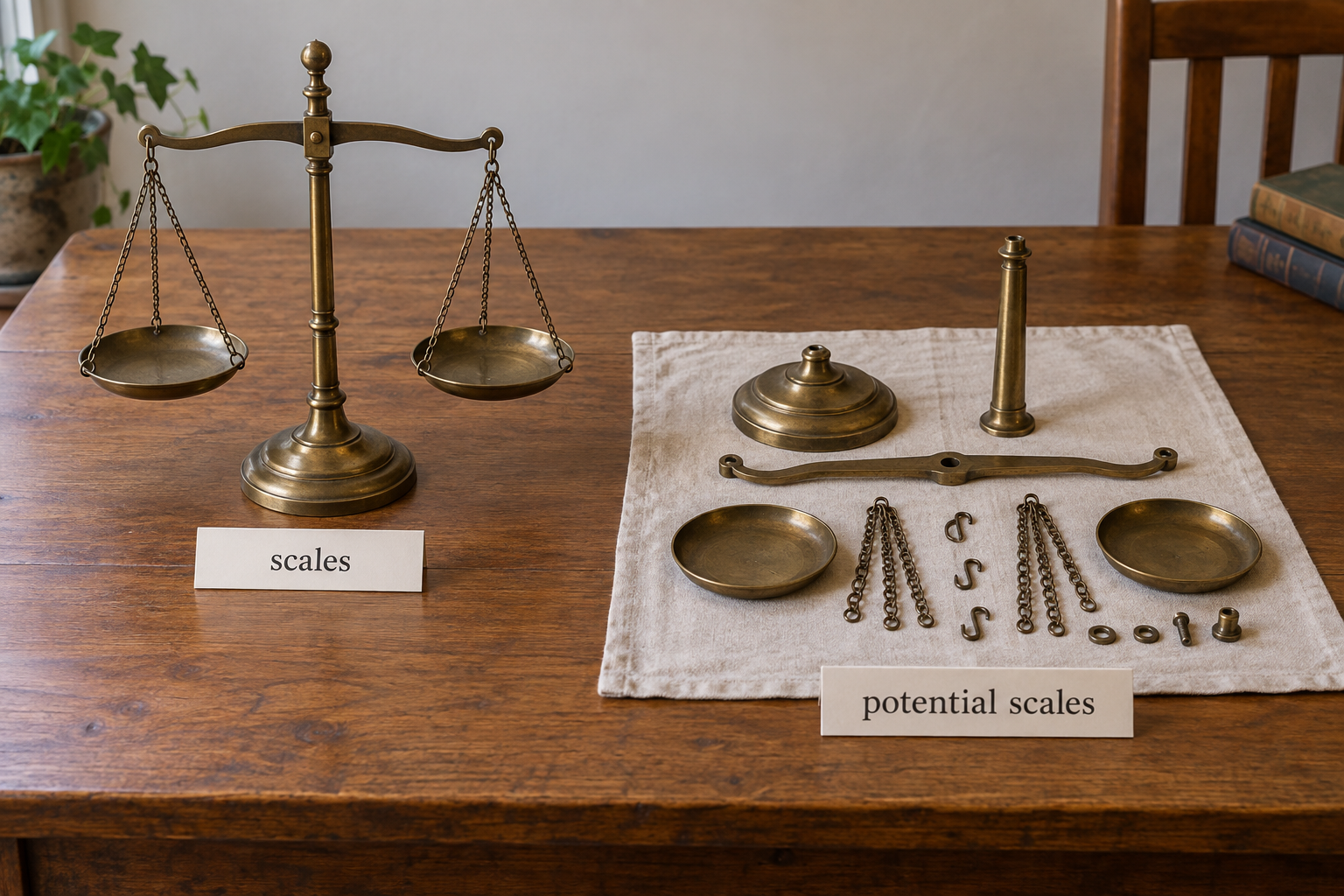
You’re examining what has been placed on the scales (in this analogy) —your ideas about realization, your attachment to them, your hope for change—and asking whether their weight is preventing you from passing through the doorway.

But the doorway isn’t reached by getting the balance right. The doorway is seeing what is involved in the scales themselves.

“Scales” sounds like one independently existing thing. Look more closely and there is a beam, pivot, pans, weights, gravity, a supporting surface and perhaps a hand placing something upon them. Each part functions only through its relationship with the others. Apart from those relationships and activities, where is the separate thing called “the scales”? It is a useful label for an ongoing process.

https://1ness.info/Scales.png

You’ve already described K as “the ever-changing pattern of perceptions and thoughts labelled ‘K.’” But perhaps the consequences of that haven’t fully landed. The label still quietly seems to refer to an actual K who possesses the perceptions and thoughts and is trying to realise something.

The pattern is not merely a collection of parts contained inside K. Each apparent part influences—and is influenced by—the body, spouse, room, language, history and innumerable conditions beyond any discoverable boundary. Even the diagram is incomplete unless those exchanges are included. K is not a thing having a process; “K” is the name given to this flowing, interconnected process.

So the ideas and attachments don’t first need to be removed. They aren’t objects blocking K’s path. They are movements within the same process: weighing, doubting, hoping and wondering happening now.

Can an actual K be found standing before the scales—or are K, the weighing and the imagined doorway all parts of this one unfolding?


v
Last edited by vinceschubert on Sun Sep 13, 2026 5:47 am, edited 3 times in total.
liberation starts with recognising some illusions

http://www.1ness.info


Return to “THE GATE”

Who is online

Users browsing this forum: Bing [Bot] and 28 guests