Seeing through

All threads where seeing happens are stored here. The complete list, sorted by guide, contains all links. The archives include threads of those that came to LU already seeing as well.
You are welcome to continue your conversation with your guide here after your name is turned blue.
User avatar
Storienie
Posts: 47
Joined: Fri Jul 03, 2026 6:08 am

Re: Seeing through

Postby Storienie » Tue Aug 18, 2026 8:14 am

Hi Rali,

I didn’t take the time yet to go on a nature walk. I did pay attention to the trees and the wind while walking. It was hard to keep focus on the questions, but I looked at the following:
Is there a border that divides “me” and “my body” from everything else, or is it just a thought? Is that interdependent movement outside of you? Is there an “inside” and an “outside”?
There is THIS, whatever is happening, and there is labeling of “inside” and “outside”, same as before. When breathing in fresh air, the air is labeled “nature” because of the earthy and plant-like smell. Air is labeled “inside” when breathed in, so that made “nature” feel inside as well as outside (when thinking about inside and outside).
Next time someone seems annoying, don’t stay with the body for long. Look at the person.
Will do. It’s hard to keep the questions in mind though, as I can’t always look them up on my phone the moment I’m getting annoyed. Easiest for me is to break experience down into hearing, thinking etc. Last time, it was clear that “annoying” is just the label in thought.
On a more practical level, would they be annoying if you we were in a better mood (thought stream a bit more cheerful that day)?
Not at all. I don’t experience “judgemental thoughts” often, and this time it was quite extreme. It’s clear to me that my mood influences the type of thoughts I have.

So notice this: does the thought ‘they are annoying’ tell you more about them, or about the current conditioning here?”
Only about here.

But in direct experience, what is actually found?
Does colour say “other”?
Does sound say “annoying”?
Does sensation say “they cause the unpleasantness”?
Does movement (colour change) say “there is an I inside them”?
Or does the backpack-story get added?
Colour is just colour, sound is sound. Thoughts add the whole story.
For next time, use a real present “other” if possible — someone neutral: a stranger, cashier, person walking by, family member, dog. Look directly:
What is actually here?
Colour (clothes, skin, texture)
Thought labeling “movement of eyes and fingers”
Sound (sniffing)
Can an “I” in them be found?
There is no “I”, just the things above
Can an “I” here be found?
Just the label “I” as a thought
What happens in sensation when thought says “they are like that and that”?
Slight change in muscles of the face (frowning), but there is no strong story coming up in thought now. More like I’m trying to find something in the other to describe.

User avatar
poppyseed
Posts: 2945
Joined: Sun May 20, 2018 5:28 pm
Location: South Africa
Contact:

Re: Seeing through

Postby poppyseed » Tue Aug 18, 2026 12:46 pm

Hi Irene
Wonderful looking!
More like I’m trying to find something in the other to describe.
That is worth exploring - not just “there is no other person,” but how a person-story gets assembled from cues.
When looking at someone, what is actually known about their intention?
Can “showing off,” “being rude,” “being kind,” “being insecure,” “wanting attention” be found in what is seen or heard?
Or are these interpretations/ conditioned judgements built from tone, facial movement, words, memory, and expectation?
When thought says, “They are like this,” what exactly is the “they” referring to?
Is there a stable entity there apart from the changing appearance, sound, behaviour, and the story about them?


Let’s leave ‘annoying’ for now. Next time you’re with someone, notice when thought forms a picture of who they are. Not whether the picture is right or wrong—just how it gets built.
What is directly given, and what is inferred? Can intention, character, motive, or personality actually be seen? Or does thought weave a person out of fragments?

Let’s explore the “relationship” of commentary versus what is happening with an exercise…
The following link is a 7 minute clip of a soccer game. If you prefer another sport…please feel free to find one to do this exercise with.
https://www.youtube.com/watch?v=Yy5pL-myDzw

1. Watch one minute with the sound turned OFF, watching ‘people’ messing about with a round thing on a field, up and down, up and down. Let it sink in, the whole experience.

2. Once the first minute is completed, now watch another whole minute with the commentary turned ON.
Notice the differences. Notice how the commentator (thought) offers lots of know-how, even advice. It seems to feel as though they can influence, somehow, what is going on, as though one outcome is much preferred to the opposite outcome - “good pass” / “bad decision” / “he should have…” / “they’re under pressure” / “this team wants it more”/ “that was careless”. The commentary may seem to heighten any supporter feelings which are there, and call for an identification with one team or other, and with the importance of the game itself.

3. Now turn the volume OFF AGAIN and just watch the action with NO audible commentary, the shapes moving around on the screen etc. Again notice all the differences in what is appearing as experience. Does the movement itself say: “good pass” / “mistake” / “pressure” / “intention” / “strategy”/ “he should have done differently”

4. Now turn the volume ON again and ignore what you think you know thought is talking about, and just notice it as sound. Notice how quickly the words organise what is seen into players, teams, motives, success, failure, cause, blame, and prediction.

What did you find when doing this exercise? Is the commentary on the soccer game a necessity for the play to happen?
And in the same way, is the inner narration of thought a necessity for the play of life to happen?
How different is this from the internal commentator saying: “I handled that badly.” / “They were rude.” / “I should have done something else.” / “This is going well.” / “This is a problem.”
Does the inner commentary describe reality directly, or does it construct a story about what is happening?


Love
Rali
Your assumptions are your windows on the world. Scrub them off every once in a while, or the light won't come in. ~Alan Alda
The mind that aims to understand reality can consider itself satisfied only by reducing it to terms of thought. ~ Albert Camus

User avatar
Storienie
Posts: 47
Joined: Fri Jul 03, 2026 6:08 am

Re: Seeing through

Postby Storienie » Tue Aug 18, 2026 5:15 pm

Hi Rali,

I enjoyed the exercise! All this gets labeled as ‘nothing new here’, but I’m guessing practice is helpful with this stuff.


When looking at someone, what is actually known about their intention?
Nothing can be known, thought can make a guess.
Can “showing off,” “being rude,” “being kind,” “being insecure,” “wanting attention” be found in what is seen or heard?
No, only a thought can be found labeling what is seen as one of these.
Or are these interpretations/ conditioned judgements built from tone, facial movement, words, memory, and expectation?
Yes
When thought says, “They are like this,” what exactly is the “they” referring to?
Color or a mental image.
Is there a stable entity there apart from the changing appearance, sound, behaviour, and the story about them?
In DE there is no stable entity, just the appearance and mental image, memory and story about them.
What is directly given, and what is inferred? Can intention, character, motive, or personality actually be seen? Or does thought weave a person out of fragments?
What is directly given:
- Colour (appearance, movement, gestures)
- Sound (voice, breathing)

What is inferred:
- background (accent, origin, age)
- Personality (“this is that type of person”)
- Intention (what they want, “this person wants to be left alone”)
- State (“this person is tired”)

I see the inference as a prediction mechanism. Often it is right and it helps navigate situations, sometimes it’s wrong and that shows once again how it’s just an inference.
Does the movement itself say: “good pass” / “mistake” / “pressure” / “intention” / “strategy”/ “he should have done differently”
No. My own thoughts gave some commentary when the sound was off, but much less than the commentator. The experience was mostly just watching images, quite neutral.
4. Now turn the volume ON again and ignore what you think you know thought is talking about, and just notice it as sound. Notice how quickly the words organise what is seen into players, teams, motives, success, failure, cause, blame, and prediction.
I’m not entirely clear on the instructions here. Noticing the commentator as sound distances my focus from the words, so it feels more like noise. A player’s name is mentioned and the person with the ball gets focus and associated with the name. Voice inflection and words like “nice” have a positive association, which makes my face muscles move slightly into a smile.
Is the commentary on the soccer game a necessity for the play to happen?
No
And in the same way, is the inner narration of thought a necessity for the play of life to happen?
No
How different is this from the internal commentator saying: “I handled that badly.” / “They were rude.” / “I should have done something else.” / “This is going well.” / “This is a problem.”
Not different at all
Does the inner commentary describe reality directly, or does it construct a story about what is happening?
It constructs a story

User avatar
Storienie
Posts: 47
Joined: Fri Jul 03, 2026 6:08 am

Re: Seeing through

Postby Storienie » Wed Aug 19, 2026 7:21 am

Hi Rali,

Yesterday evening I re-examined most of what we have discussed so far to see if there was any doubt. Everything felt clear around the labels inside and outside, me and others, making choices, and the expression “life experiencing itself” came up to describe it, which was a sentence I didn’t connect to before.

There is one thing that I don’t understand and has been bugging me for years, and that is “identifying with thought”. I don’t know what in direct experience this can be referring to. Perhaps it’s not relevant to discuss, but I wanted to share in case it can clarify more things.

There are different states in experience, like being focused on a task, which makes other sound and feeling appear less intense, or daydreaming, which makes thoughts more in the foreground. There can be a calm meditative state where not much comes up and there is more “empty space” as we discussed before. But all these are just different colours, sounds or thoughts coming up in different amounts.

You mentioned a few times that the trap is believing there is a separate “thinker” or “doer”, that there is an “I here” observing “that over there”. But isn’t any belief just a story in thought? A “you” believing a thought is also a thought.

I don’t want to think about this too much and just build another story, but I don’t know where to look to see it clearly without the story.

User avatar
poppyseed
Posts: 2945
Joined: Sun May 20, 2018 5:28 pm
Location: South Africa
Contact:

Re: Seeing through

Postby poppyseed » Wed Aug 19, 2026 1:29 pm

Hi Irene
Wonderful!
Some points that need further checking:
I see the inference as a prediction mechanism. Often it is right and it helps navigate situations, sometimes it’s wrong and that shows once again how it’s just an inference.
That's not DE. That's a model about life. Notice what's packed into that sentence: there is a future, there are other people "out there"; there are enduring entities whose future behaviour can be predicted; thought predicts reality; the prediction can be right or wrong. None of that is found.
The subtle point isn't that prediction doesn't happen functionally. Of course it does. The issue is that the model does not correspond to reality. Let’s look properly…
Right about what?
Can "the future" be found?
Can another person's future action be found?
Can a future event be compared with the present prediction?
Or is there only: a present thought predicting, another present thought saying, "It was right," or "It was wrong"?

You says: "...it helps navigate situations." Again:
What is a "situation"?
Can a situation be found apart from present colours, sounds, sensations and thoughts?
Or is "situation" another convenient story that groups together what thought has already divided?


We are not attacking functionality and conventional language here. Here we are interested in the DE/ what is really here. We are not asking whether these stories are useful. We are asking whether they are found.
Often it is right.
What does "right" mean? Right compared to what?
Compared to another thought occurring later?

Just like change / sameness / cause / prediction /success / failure, all require comparison.
So "the prediction was right" is itself another commentary. There is never a prediction standing next to a future event to compare. There is:
present thought → present thought saying "it matched."
That's all.
There is one thing that I don’t understand and has been bugging me for years, and that is “identifying with thought”. I don’t know what in direct experience this can be referring to…

…But isn’t any belief just a story in thought? A “you” believing a thought is also a thought.
I'm glad you brought this up. Let's look. So forget the word identification for a moment.
When the thought appears: "I am not doing enough", what happens? Not why. Not who believes it. Just what actually happens.
Does another thought appear trying to solve it?
Does planning begin?
Does contraction appear?
Does life simply continue?

Notice that none of this requires a thinker/a believer. The thought doesn't need someone to believe it in order for consequences to unfold. The same way a commentator during the soccer match doesn't need a listener called "me" for commentary to keep happening.
Does the story have to be believed in order to have an effect?
Or is "believing" itself simply another story told afterwards?

You asked what "identifying with thought" refers to. Let's look.
So where does identification happen?
Not in a believer. It happens when one thought refers to another thought as "me" without being seen through. For example: a thought "I'm not doing enough”, then another thought "Yes, that's true." / "I need to improve", or even "I shouldn't identify with that thought."
Notice that the second thought is not checking DE. It is taking the first thought as reality. It is a thought about a thought.
Suppose a thought appears "I am not good enough." Now don't ask whether anyone believes it. Instead, watch what the next thought does.
Does it “look” again?
Or does it simply continue the story?

For example: "I need to improve." - "That's always been my problem." - "I shouldn't think like this." - "This isn't true."
Notice that each of these is another thought referring to the previous thought.
Is there any point where the chain returns to direct looking? Or does thought simply comment on thought?
When a thought is taken as the starting point for the next thought, without looking, isn't that what we call "identification"?
Not because there is an identifier, but because the content of thought is treated as reality instead of being looked at.
Now try this during the day. Whenever you notice a charged thought, don't analyse the first one. Watch the second one.
Does it look?
Or does it simply continue the narrative?


Identification isn't an entity identifying. It's the continuation of a thought-chain without returning to direct experience. That is why sometimes a thought simply comes and goes, while other times it snowballs into suffering. Not because there's a believer, but because the chain never leaves thought.
It's that subsequent thoughts build on the first instead of looking again. Once that recursive loop is seen, "identification" loses its mysterious status.
The difference is:
thought → thought → thought...
versus
thought → LOOK.

One thing I would gently challenge is this:
life experiencing itself came up to describe it
Earlier you saw that experiencing is also just a label.
Is there actually life experiencing itself?
Or is that another beautiful description, no different in structure from "I am experiencing life"?


When I suggested THIS - THIS isn't another thing. It isn't an experience. It isn't reality. It isn't awareness. It's simply a way of saying: Stop. Look.

Love
Rali
Your assumptions are your windows on the world. Scrub them off every once in a while, or the light won't come in. ~Alan Alda
The mind that aims to understand reality can consider itself satisfied only by reducing it to terms of thought. ~ Albert Camus

User avatar
Storienie
Posts: 47
Joined: Fri Jul 03, 2026 6:08 am

Re: Seeing through

Postby Storienie » Thu Aug 20, 2026 7:14 pm

Hi Rali,

That's not DE. That's a model about life. Notice what's packed into that sentence: there is a future, there are other people "out there"; there are enduring entities whose future behaviour can be predicted; thought predicts reality; the prediction can be right or wrong. None of that is found.

... Let’s look properly… Right about what?
You are right that it is a model and not DE.

In DE, there is no “prediction” entity that is “right”. There are thoughts that say “this was predicted” or “I predict this” or “the prediction wasn’t right”.
The subtle point isn't that prediction doesn't happen functionally. Of course it does. The issue is that the model does not correspond to reality.
Does a model ever correspond to reality? Are you saying that no model corresponds to reality or something else I’m not understanding?

I get confused thinking about the difference between “functionally” and a model.
“Prediction happens functionally” to me means: thoughts appear saying something is predicted, expected, etc or thoughts saying “in the future this will happen”.

Does prediction exist outside of thoughts? No, outside of thoughts things are just happening.

But a model is also thought describing experience, so to me both are the same.

Can "the future" be found?
No, there is just thought and images labelled “future”

Can another person's future action be found?
No
Can a future event be compared with the present prediction?
No, there can only be a memory-thought being compared to the present seeing/feeling/thinking.
Or is there only: a present thought predicting, another present thought saying, "It was right," or "It was wrong"?
Yes

What is a "situation"?
A label in thought for a group of colours, thoughts, sounds etc. I wanted to say “in a section in time” but that’s also a label in thought. Labels point to other labels and it gets confusing to explain from DE when I look.

Can a situation be found apart from present colours, sounds, sensations and thoughts?
No
Or is "situation" another convenient story that groups together what thought has already divided?
Yes, that’s a clear way to put it.
What does "right" mean? Right compared to what?
Compared to another thought occurring later?
“Right” is just a thought that labels something as “right” or “expected”. There are present thoughts and their content may be about predicting in the future or evaluating the past, but that doesn’t mean that there exists an actual “future” “past” or “prediction” in DE. “Right” only appears when comparing to a memory-thought.
There is:
present thought → present thought saying "it matched."
That's all.
Yes
When the thought appears: "I am not doing enough", what happens?
It’s not appearing by itself now, but if I bring up a scenario and imagine having that thought, I can imagine thoughts appearing analyzing why I am or am not doing enough, convincing myself that it’s ok to not do enough or planning what needs to happen so I am doing enough.
Does another thought appear trying to solve it?
Does planning begin?
Does contraction appear?
Does life simply continue?
Yes to solving and planning, perhaps also a contraction or other sensation. Sometimes it’s easy to let the thought pass, and then life simply continues.
Does the story have to be believed in order to have an effect?
No, and I would say that the story also doesn’t have an effect. Colour or thoughts appear and then other colour or thoughts appear, the story-thought comments on it but doesn’t cause anything.
Or is "believing" itself simply another story told afterwards?
Yes, belief is just a story in thought

Whenever you notice a charged thought, don't analyse the first one. Watch the second one.
Does it look?
Or does it simply continue the narrative?
I understand the explanation, thanks! Often when I answer your questions I catch thoughts about thoughts, but that doesn’t happen often outside of these reflections. I will do this exercise today and tomorrow!
Is there actually life experiencing itself?
Or is that another beautiful description, no different in structure from "I am experiencing life"?
Yes, it’s just a description. At the time it seemed like a very good one, and eye-opening because it didn’t involve the “I”, but I can’t connect to it anymore today, so I let it go.

User avatar
poppyseed
Posts: 2945
Joined: Sun May 20, 2018 5:28 pm
Location: South Africa
Contact:

Re: Seeing through

Postby poppyseed » Fri Aug 21, 2026 1:58 pm

Hi Irene,
Good.
Does a model ever correspond to reality? Are you saying that no model corresponds to reality or something else I’m not understanding?

I get confused thinking about the difference between “functionally” and a model.
“Prediction happens functionally” to me means: thoughts appear saying something is predicted, expected, etc or thoughts saying “in the future this will happen”.
Does prediction exist outside of thoughts? No, outside of thoughts things are just happening.
But a model is also thought describing experience, so to me both are the same.
What matters is simply:
What is actually found?
Thoughts are here (icons on the desktop – functionality/flow), but is there any model / understanding / knowing that reflects “reality”? Even saying “thoughts” or "reality" is not real…
I like this quote from Albert Camus: “The mind that aims to understand reality can consider itself satisfied only by reducing it to terms of thought” :). Nothing thought say is reality – only icons on your desktop, instead of 0’s and 1’s. Thoughts are always out of step with reality, and they obstruct the clear seeing of how things actually are - the illusion. "Reality" is very simple. Once it is seen, there is no endless frustration of trying to figure out how things are.
Just look, what is it that is separate from what is, and trying to figure out how things are?
Is there a self or me here, who is separate and isolated from what is, from reality, and thus is in need to understand reality, to construct models of reality?

Truth or reality is not an idea or a belief. It cannot be grasped by thoughts. It does not need to be understood by thought. Actually, it is impossible to understand through thoughts. It is inconceivable, ungraspable. And yet, it can be directly “seen”. Any form of description is an abstraction, which is added after the immediate experience.
Often when I answer your questions I catch thoughts about thoughts, but that doesn't happen often outside these reflections.
Yes. Notice that when we investigate together, something interrupts the ordinary chain.
A thought appears. Then instead of another thought continuing the story... LOOKING happens.
That is all.
So during the day, don't try to analyse thoughts. Just notice whether the next thought continues the previous one, OR whether there is simply looking. Nothing needs to interrupt the chain. No one needs to interrupt the chain. Just notice whether thought keeps referring to thought... or whether looking happens.
Sometimes it's easy to let the thought pass.
When a thought passes, is there someone allowing it to pass?
Or does passing simply happen?


Love
Rali
Your assumptions are your windows on the world. Scrub them off every once in a while, or the light won't come in. ~Alan Alda
The mind that aims to understand reality can consider itself satisfied only by reducing it to terms of thought. ~ Albert Camus

User avatar
Storienie
Posts: 47
Joined: Fri Jul 03, 2026 6:08 am

Re: Seeing through

Postby Storienie » Sat Aug 22, 2026 4:44 pm

Hi Rali,
Just look, what is it that is separate from what is, and trying to figure how things are?
I don’t know. There are thoughts asking your question, thoughts about “me” (memories and associations with the word “me”), then just no thoughts, feeling pops up, then a thought labeling the lack of finding something concrete “frustrating”, then looking for feeling, thought says ‘there is no feeling that can be labeled “frustrating”’… it’s just thought jumping from one thing to the next whenever I try to “find what is separate”. Then the trying to find just stops, I get distracted or tired.

Over the last day I remember recognising a few times how a second thought was going on about the previous thought. The thought chain then stopped by itself.

Is there a self or me here, who is separate and isolated from what is, from reality, and thus is in need to understand reality, to construct models of reality?
I can’t find it. I just find thoughts and sensations.
When a thought passes, is there someone allowing it to pass?
Or does passing simply happen?
Passing happens by itself, thought appears and then disappears.

User avatar
poppyseed
Posts: 2945
Joined: Sun May 20, 2018 5:28 pm
Location: South Africa
Contact:

Re: Seeing through

Postby poppyseed » Sat Aug 22, 2026 7:45 pm

Hi Irene
Wonderful!
Then the trying to find just stops, I get distracted or tired.
Yes, thought is in a hurry to comment on the next thing, appearing as a “distraction” or “tiredness”
I can't find it. I just find thoughts and sensations.
Exactly!

So let's review where we are.
What has changed in normal everyday living since we started this dialogue?
What has not changed?
What is the biggest difference, if any, from before starting this conversation?
Has anything been gained? Has anything been lost?
Is seeking still going on? If so, what exactly is still being sought (and by whom)?
Is there any confusion remaining or anything you would like to address?
Can you say with a big fat YES, it is clear what the illusion of a separate self is?


Please answer from direct experience rather than from memory or understanding.

Love
Rali
Your assumptions are your windows on the world. Scrub them off every once in a while, or the light won't come in. ~Alan Alda
The mind that aims to understand reality can consider itself satisfied only by reducing it to terms of thought. ~ Albert Camus

User avatar
Storienie
Posts: 47
Joined: Fri Jul 03, 2026 6:08 am

Re: Seeing through

Postby Storienie » Sun Aug 23, 2026 1:35 pm

What has changed in normal everyday living since we started this dialogue?
Not much. There is breaking down into “colour” “sound” “thought” sometimes, there is also recognising thought about thought sometimes. Apart from these small moments there is nothing that changed.

What has not changed?
There is still chains of thoughts that aren’t recognised most of the day, and experience that isn’t broken down/ looked at.
What is the biggest difference, if any, from before starting this conversation?
I know how to look at DE and check whether I find something in DE or only in thought.
Has anything been gained? Has anything been lost?
I wouldn’t put it like that. There are just the slight changes described above.
Is seeking still going on? If so, what exactly is still being sought (and by whom)?
I don’t experience any active seeking right now, but there is no sense of “everything being clear” or being “done” either.
Is there any confusion remaining or anything you would like to address?
There is no confusion right now. Thought says “I need more practice looking at DE”. Even writing this sentence it takes a few moments to recognise it as a thought and look if there is an “I”. I was already starting on the next question and then went back.
Can you say with a big fat YES, it is clear what the illusion of a separate self is?
No. I cannot find a self, but I can’t find an illusion either. Only conceptually/ by thinking I can come up with something of what the illusion might be, but not in DE

User avatar
poppyseed
Posts: 2945
Joined: Sun May 20, 2018 5:28 pm
Location: South Africa
Contact:

Re: Seeing through

Postby poppyseed » Sun Aug 23, 2026 4:15 pm

Hi Irene
I cannot find a self, but I can't find an illusion either.
Good. That is worth exploring, because you’re treating illusion as though it should be another object in DE.
What exactly are you expecting to find?
Is "illusion" supposed to be another object in direct experience?
When a mirage is recognised as a mirage, is there an "illusion" left to find?
Or is there simply the absence of what had been assumed?


Earlier you found that: "I" is a thought / "thinker" is a thought / "controller" is a thought / "chooser" is a thought. What exactly is the illusion, if not taking those thoughts to refer to something that cannot be found?
There is no sense of everything being clear.
I actually wouldn't worry about that. LU isn't about acquiring certainty. Many people expect a dramatic shift, and when it isn't there they think they haven't seen. You may be thinking that this is not enough, that some experiences need to happen, that you should be happy and blissful all the time :)

Expectations are one of the most frequent blocks to seeing what ‘reality’ actually is. We can blame Guru stories and the attraction to drama in our society for focusing on stories of the initial epiphany that people have as they wake up (because some have a ‘wow’ factor). This puts into our head, the idea of “bells and whistles”. We expect high drama to confirm that a significant shift has occurred. In many cases it happens quietly and gradually, as believes come one by one to be seen through. It may take days, months or years and it very much depends on the acquired conditioning. It also is self-organised - thoughts restructuring around the fact that there is no self, seen one belief at a time. It doesn't happen automatically - e.g. once it's seen no self and then ALL beliefs drop on the spot - nope. Resistance and strong emotions (fear, anger, blame, guilt) become a very good tool for spotting believes that are still lingering around. Question what you know is true. This falling away of old beliefs happens whether you do work on that or just stay with what is present, the process takes care of itself. Sometimes it is intense, sometimes it’s gentle, but there is no landing, only
falling deeper and deeper into peace. As I warned you in the beginning of the inquiry:
I can promise you there will be no fireworks; it is just a subtle shift in perception! The only true expectation, that you can have, is that the seeking will end. If there are any other expectations, it's good to acknowledge them and then set them aside. It is all much simpler and ordinary.
Some common misconceptions:
That I will experience permanent bliss.
That I will be able to stop my thoughts.
I will be able to manifest prosperity.
I will never hurt others again
I will never develop dementia
I will never have any more interpersonal conflicts
I will never again get angry
I will never be hurt
I will be loved (approval of others)
I will always know what to do (control)
I will always feel good (control feelings / bliss)
:)

Seeing usually is not 24/7. There's usually a "honeymoon period," and then what we call, "got it, lost it," as untrue beliefs come up to be questioned. This can go on for months and years. This initial shift is irreversible, just as we can never go back to believing in Santa Claus or the Tooth Fairy. We still use first-person pronouns to describe “ourselves” with the same ease we always had, even if such ideas have no more actual meaning than talking about Santa Claus once we learn “he” doesn’t exist either. The separate “self” is seen to have been nothing more than inference and interpretation.
As a result of getting this first irreversible understanding of who we aren’t there is a joyfulness or easiness, an initial cleansing of wrong views, and an illumination of what is (and is not) happening within and around us. Even though this illumination is temporary, it nevertheless constitutes a significant re-ordering of how we perceive ourselves and our place in the world.

This video could be quite useful :
https://youtu.be/vJQcD588g2w

You can also inquire into the “sense of everything being clear” What would that sense be? A sensation, a thought? Would the sensation know what “being clear” is? Does it contain the clarity or lack of clarity?
So what’s left is thought… Is that doubtful thought (e.g. of lack of clarity) even yours or about you?
What is that entity that is outside of THIS, and is still confused or doubtful, or not being clear about THIS


You wrote:
I cannot find a self.
Was there ever one?
Looking now, has there ever been anything other than thoughts referring to "I"?

Because that's really what the illusion is. Not a thing called illusion. Just the mistaken assumption that the word "I" referred to something independently existing.
So the question is as always
Can an entity called Irene/I/me or anything else be found as a doer, controller, thinker, etc..., or is it just language?
Love
Rali
Your assumptions are your windows on the world. Scrub them off every once in a while, or the light won't come in. ~Alan Alda
The mind that aims to understand reality can consider itself satisfied only by reducing it to terms of thought. ~ Albert Camus

User avatar
Storienie
Posts: 47
Joined: Fri Jul 03, 2026 6:08 am

Re: Seeing through

Postby Storienie » Tue Aug 25, 2026 7:52 am

Hi Rali,

I haven’t finished answering all the questions, but here is what I have so far for the daily update. I think the last few questions about what ‘clarity’ means to me will be helpful, so I will answer them as soon as I can.

What exactly are you expecting to find?
I’m expecting some ‘aha’ moment or feeling of certainty. I know expectations are not helpful here, but there are thoughts saying ‘this can’t be it, nothing has changed’. I also know you said that thought will not be able to grasp anything here because it can’t be seen in thought, but still thoughts doubt and struggle. There are just these thoughts and slight frowning sensation in DE.
Is "illusion" supposed to be another object in direct experience?
I don’t see how it could be in DE, but when you see though an illusion there is a sense of understanding the trick, right? I don’t know what the trick was. I expect that the ‘aha’ moment will be found in DE as feeling and thought.
When a mirage is recognised as a mirage, is there an "illusion" left to find?
No, but what caused the mirage should be clear, how when you look this way you can see how you misinterpreted what happened. (This would all be thought explaining what the illusion was.)

For me, I don’t see what I misinterpreted. There are just thoughts that say “I”. All “I” is, is a thought. Maybe I forgot what it is like to believe in a self and that’s why thoughts don’t explain the ‘before’ and ‘after’, or maybe I’m just kidding myself.
I often get to the conclusion that there’s no need to keep arguing in thoughts about this, better to just go and live life, but I still came to this forum. I’m just not sure.
Or is there simply the absence of what had been assumed?
I also don’t find a clear absence of what had been assumed. With “emptiness” it was clear that it was the absence of thoughts or other things. With “I” it is less clear. Maybe because I still find the “I”-thought, the mental images and sensations associated with “me”.

Perhaps the point of struggle is that we have looked at what is in DE and what is in thought, but the “I”- thought still serves a purpose, like memory or the concept of past and future. I’m not sure if accepting its purpose makes me hold 2 beliefs at the same time, a useful self-concept and a no-self, or if the second is not a belief. When I look at the self, I find thought, so that’s not a belief, but still there is doubt because the “I” narrative is constantly there and useful.
What exactly is the illusion, if not taking those thoughts to refer to something that cannot be found?
Ok. The future cannot be found, the thinker cannot be found, a table cannot be found, but they are all useful labels. The illusion is assuming they are definitely there, existing, when in DE there is no proof of that. Believing that the label is a real thing out there, without looking closely at what appears in DE.

I’m checking in DE while writing this to be certain of what I write, but there are still thoughts doubting whether it’s not just another theory.

User avatar
poppyseed
Posts: 2945
Joined: Sun May 20, 2018 5:28 pm
Location: South Africa
Contact:

Re: Seeing through

Postby poppyseed » Tue Aug 25, 2026 9:52 am

Hi Irene

I want to add this to my previous reply for your consideration…
The 'I'-thought still serves a purpose.
Exactly. Think of a mirage. When you recognise it as a mirage, does the shimmering appearance disappear? No. The appearance remains. What disappears is the assumption that it is water.
Or think of the Müller-Lyer illusion. Even after measuring the lines and knowing they are the same length, they still look different. The illusion isn't destroyed—it is seen. There is a difference between an illusion and a delusion. Illusion is when something can be seen as something else, but the truth of what is real is known. Delusion is when the illusion is believed to be true. The same applies here.
The thought "I" does not need to disappear. Memories do not need to disappear. The body image does not need to disappear. Functional language does not need to disappear. The question has always been:
Does the thought "I" point to an independently existing entity?
Or is that the assumption that has been seen through?
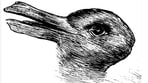
Look at this picture.
Image
At first you may see a duck. Then someone points out that it is also a rabbit. After that, the image itself does not change. You don't have to force yourself to see the rabbit, nor can you permanently go back to seeing only the duck. The same lines are still there.
What has changed? Not the appearance. Only what is recognised.
The illusion wasn't "wrong lines." The illusion was taking one interpretation to be the only reality. The same is true here. The thought "I" does not have to disappear. The appearance remains. What changes is that the thought "I" is no longer taken to point to an independently existing self.
That is why an illusion is different from a delusion. A delusion disappears when it is corrected. An illusion may continue to look exactly the same, even after the truth about it is known.
As Philip K. Dick beautifully put it: "Reality is that which, when you stop believing in it, doesn't go away."
The thought "I" may continue to arise, just as the duck continues to look like a duck. The question is simply:
Does the thought "I" point to anything that can actually be found?

Let me offer you something to contemplate—not as something to believe, but as something to look at. Here is a Mahāmudrā koan for you:
Is there a difference between abiding in tranquillity and moving in thought?
Don't answer conceptually. Look.
Another old Buddhist saying points in the same direction: "Before enlightenment, chop wood and carry water. After enlightenment, chop wood and carry water."
Nothing needs to disappear. Thoughts continue. The word "I" continues. Memory continues. Planning continues. The body moves. Conversations happen. Life unfolds. What changes is not the appearance, but what is taken to be true about it. The separate "I" that was assumed to be thinking, choosing, controlling and experiencing cannot be found.

Was the illusion ever the thought itself?
Or was it only what thought was assumed to refer to?

Nothing essential needs to change for the illusion to be seen. The appearance may remain exactly as it always was; only the assumption about what it points to is no longer taken at face value.

Love
Rali
Your assumptions are your windows on the world. Scrub them off every once in a while, or the light won't come in. ~Alan Alda
The mind that aims to understand reality can consider itself satisfied only by reducing it to terms of thought. ~ Albert Camus

User avatar
Storienie
Posts: 47
Joined: Fri Jul 03, 2026 6:08 am

Re: Seeing through

Postby Storienie » Tue Aug 25, 2026 8:26 pm

Hi Rali,

Thanks, the example of the mirage is perfect. I was thinking of the duck/rabbit illusion as well yesterday, but the mirage hit the mark for me.
There is a difference between an illusion and a delusion.
Nice distinction, this helps! The illusion is still there and can be seen. Sometimes you might still mistake the mirage for water, but if you look closely you will see it’s just a mirage.
Is there a difference between abiding in tranquillity and moving in thought?
I’m not very sure what these point to. “Abiding in tranquility” I take to be like resting peacefully, not many thoughts appearing, calm sensations in the body. “Moving in thought” is less clear, perhaps seeing many thoughts appear and disappear (the movement of thoughts).

In both cases things are appearing (thoughts and sensations) like when I experienced “emptiness” or all the “judging thoughts”.

Was the illusion ever the thought itself?
No, the thought itself is not an illusion.
Or was it only what thought was assumed to refer to?
Yes. For me, the illusion is taking the thought “me” and believing the content of that thought to be real without stopping to question whether there is more to it than just the thought.

When I think “Of course I am real, here I am!” I can bring up a feeling of indignation, eyebrows can frown and I can feel ready to fight anyone saying the opposite. But then I can stop and break down the thoughts and sensations and see that there is nothing more to it than those thoughts and sensations.


To go back to your earlier questions:
You can also inquire into the “sense of everything being clear” What would that sense be? A sensation, a thought? Would the sensation know what “being clear” is? Does it contain the clarity or lack of clarity?
I now realise that I had some more expectations: no more thoughts doubting, constantly looking in DE instead of having chains of thoughts, perhaps having some elated feeling.
Doubtful thoughts are just thoughts though, so what their content is doesn’t matter to seeing through the illusion. Same for feelings. Constantly looking in DE perhaps doesn't happen or will come with practice, I don’t know.
So what’s left is thought… Is that doubtful thought (e.g. of lack of clarity) even yours or about you?
No, just thought.
What is that entity that is outside of THIS, and is still confused or doubtful, or not being clear about THIS
There is no entity outside THIS, there are just thoughts
Was there ever one?
No, can’t have been
Looking now, has there ever been anything other than thoughts referring to "I"?
No, it’s not possible for it to be anything other than thoughts.
Can an entity called Irene/I/me or anything else be found as a doer, controller, thinker, etc..., or is it just language?
It’s just language.


It’s pretty clear now that we have discussed my doubts. I think it has been or is being a very gradual shift, so there is no clear ‘before’ and ‘after’, which was confusing. But I don’t have any doubts right now.

User avatar
poppyseed
Posts: 2945
Joined: Sun May 20, 2018 5:28 pm
Location: South Africa
Contact:

Re: Seeing through

Postby poppyseed » Wed Aug 26, 2026 9:20 am

Hi Irene
Wonderful!! It seems the doubts we have been looking at have dissolved.
Is there a difference between abiding in tranquillity and moving in thought?
I’m not very sure what these point to. “Abiding in tranquility” I take to be like resting peacefully, not many thoughts appearing, calm sensations in the body. “Moving in thought” is less clear, perhaps seeing many thoughts appear and disappear (the movement of thoughts).

In both cases things are appearing (thoughts and sensations) like when I experienced “emptiness” or all the “judging thoughts”.
"Moving in thought" in LU language would be "thinking"/"not looking", and "abiding in tranquility" would be "looking"/no thoughts. So basically asking: Is there a difference between looking and not looking in the context of the following quote?:
Constantly looking in DE perhaps doesn't happen or will come with practice, I don't know.
Notice that "constantly looking" is another expectation. Looking happens when it happens. Is very much self-organised :)

Life isn't divided into "looking" and "not looking". Thoughts, sensations, colours, sounds—all of it is already THIS. There is no separate observer who has to maintain a state called "looking." How is it possible to "maintain" looking in time? Present moment is just one present moment, and has anything to do with a duration of a certain state.

We have some checkpoint questions. Would you like to answer these?

But before I ask these, just sit with this for a day or two. Don't try to hold on to anything and don't try to recreate any state. Just live normally.

Love
Rali
Your assumptions are your windows on the world. Scrub them off every once in a while, or the light won't come in. ~Alan Alda
The mind that aims to understand reality can consider itself satisfied only by reducing it to terms of thought. ~ Albert Camus


Return to “ARCHIVES”

Who is online

Users browsing this forum: Majestic-12 [Bot] and 34 guests